Bloodstain Pattern Analysis: What Blood Evidence Can and Cannot Prove
6/9/20265 min read
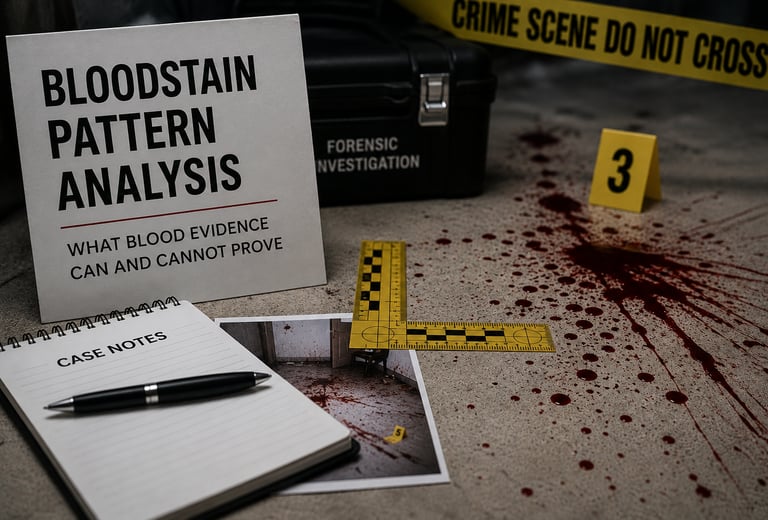
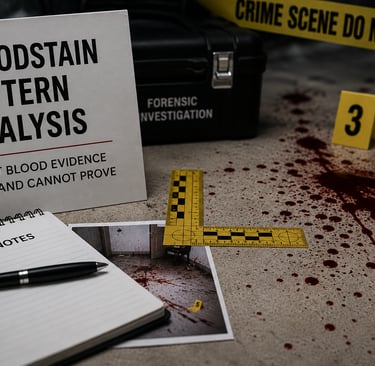
Blood evidence can be one of the most powerful forms of physical evidence in a criminal case. It can help establish movement, sequence, location, directionality, and whether a statement is consistent with the physical scene. It can also raise serious questions about the State’s theory of prosecution when the blood evidence does not match the allegations, witness statements, or police narrative.
However, blood evidence can also be misunderstood, overstated, or interpreted without proper context.
Bloodstain pattern analysis is a forensic discipline that evaluates the size, shape, distribution, location, and characteristics of bloodstains. In criminal defense investigations, the issue is not simply whether blood was present. The issue is whether the physical evidence supports the version of events being presented.
At PMI | Preventative Measures Investigation, blood evidence review is approached as part of a broader defense investigation. That may include reviewing crime scene photographs, police reports, body camera footage, witness statements, autopsy reports, lab reports, diagrams, timelines, and expert findings.
Blood Evidence Must Be Interpreted Carefully
Blood at a scene does not automatically tell a complete story. The location, absence, pattern, transfer, pooling, saturation, or distribution of blood must be evaluated within the full context of the scene.
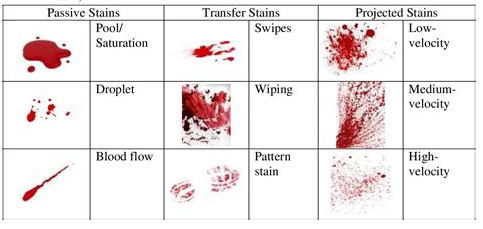
Investigators and forensic experts may consider whether stains are consistent with:
impact;
transfer;
cast-off;
pooling;
saturation;
dripping;
contact;
movement;
cleanup;
secondary transfer.
But bloodstain pattern analysis has limits. It may help evaluate whether a statement is consistent with physical evidence, but it does not always prove intent, identify every movement, or explain every event that occurred.
That distinction matters. A responsible investigation must recognize both the value and the limitations of forensic evidence.
Why Blood Evidence Should Be Independently Reviewed
In serious criminal cases, the prosecution may rely heavily on crime scene interpretation. If the State’s theory depends on how blood was deposited, where people were standing, whether someone moved after injury, or whether a witness statement matches the scene, the defense should consider an independent review.
Blood evidence can affect major questions, including:
Was the alleged sequence of events physically possible?
Does the scene support the witness statement?
Was the injured person stationary or moving?
Was there contact between two people?
Is there evidence of cleanup or disturbance?
Was the scene fully documented before items were moved?
Do the photographs support the written report?
Are there missing photos, missing evidence, or unexplained gaps?
The defense does not have to accept the State’s interpretation without scrutiny. Physical evidence should be tested against the facts, not forced into a theory.
The Role of the Defense Investigator
A defense investigator does not replace a qualified forensic laboratory or certified bloodstain pattern expert. When expert testimony is needed, attorneys may need to retain a properly qualified forensic expert.
PMI’s role is to support the defense investigation by reviewing discovery, identifying inconsistencies, organizing evidence, developing timelines, locating witnesses, and assisting counsel in determining whether expert review is necessary.
This may include:
reviewing crime scene photographs;
comparing witness statements to physical evidence;
identifying missing discovery;
reviewing law enforcement reports for assumptions;
examining whether the scene was properly documented;
evaluating whether additional records should be requested;
preparing investigative summaries for counsel;
assisting with scene review when legally permissible;
coordinating with forensic consultants or expert witnesses.
The objective is not to force a conclusion. The objective is to determine whether the available evidence supports the allegation, contradicts the allegation, or requires further forensic review.
What Can Go Wrong in Blood Evidence Cases
Blood evidence can become problematic when the scene is poorly documented, contaminated, moved, photographed incorrectly, or interpreted too narrowly.
Potential issues include:
photographs taken after items were moved;
lack of scale markers in photographs;
incomplete scene coverage;
poor lighting or unclear images;
failure to document all rooms, surfaces, or clothing;
assumptions written into police reports as facts;
inconsistent terminology;
failure to preserve relevant items;
contamination by first responders, witnesses, officers, or bystanders;
unexplained blood transfer;
conclusions that exceed what the evidence can support.
These issues can matter greatly in criminal defense. A single assumption in a report may influence how prosecutors, jurors, or even defense counsel view the case. That assumption should be tested.
Bloodstain Pattern Analysis Has Scientific Limits
Modern forensic practice increasingly recognizes that bloodstain pattern analysis, like other pattern evidence disciplines, must be evaluated carefully. The National Institute of Justice has discussed research into bloodstain pattern analysis error rates and noted that such studies are important for courts to understand the limits of expert testimony.
NIJ has also reported that research into the accuracy and reproducibility of bloodstain pattern analysis found that terminology and lack of consensus standards can affect conclusions, reinforcing the importance of careful interpretation and review.
This does not mean bloodstain evidence has no value. It means that conclusions must be supported, limited to what the evidence can reasonably show, and reviewed by properly qualified professionals when the case depends on forensic interpretation.
Blood Evidence and Reasonable Doubt
Blood evidence can create reasonable doubt when the physical facts do not match the State’s theory.
For example:
a witness may describe a position that does not match the blood distribution;
alleged contact may not produce expected transfer;
the location of blood may suggest movement inconsistent with the report;
a timeline may not fit the physical scene;
the scene may show signs of disturbance or cleanup;
the State’s theory may fail to explain all relevant blood evidence.
In a criminal defense case, the issue is not whether the defense can prove an entirely different theory. The issue may be whether the State’s theory is reliable, complete, and supported by the physical evidence beyond a reasonable doubt.
Questions Attorneys Should Ask in Cases Involving Blood Evidence
When a criminal case involves blood evidence, defense counsel should consider asking:
Were all crime scene photographs provided in discovery?
Were the photographs taken before anything was moved?
Are scale markers visible in the photographs?
Was every relevant stain documented?
Were clothing, weapons, bedding, flooring, vehicles, or other surfaces preserved?
Was DNA testing completed?
Were presumptive or confirmatory blood tests performed?
Does the report separate observation from interpretation?
Do witness statements match the physical evidence?
Was the scene contaminated by first responders, officers, witnesses, or family members?
Was any blood evidence collected but not tested?
Does the State’s theory explain all relevant blood evidence?
If these questions cannot be answered from the discovery, further investigation may be necessary.
Florida Investigative and Evidence Considerations
Private investigative services in Florida are regulated under Chapter 493, Florida Statutes, which governs private investigative, private security, and repossession services. Florida law requires private investigative work to be performed through properly licensed individuals and agencies.
Any investigation involving recordings, statements, or electronic communications must also be handled lawfully. Florida Statute § 934.03 addresses the interception and disclosure of wire, oral, and electronic communications. Evidence gathered unlawfully can damage a case and create legal exposure.
For criminal defense attorneys, this matters. The defense investigation must not only be thorough; it must also be lawful, ethical, and capable of supporting the attorney’s litigation strategy.
PMI’s Approach to Blood Evidence Review
PMI | Preventative Measures Investigation assists criminal defense attorneys by reviewing the case beyond the surface of the police report.
Our work may include:
discovery review;
timeline development;
witness identification;
scene and photograph review;
investigative summaries;
coordination with forensic experts;
identification of missing records;
review of inconsistencies between reports, statements, and physical evidence.
When blood evidence is part of the case, the defense needs to know whether the evidence supports the State’s version of events or whether it raises unanswered questions.
Bloodstain pattern analysis can be a critical component of criminal defense investigation, but it must be handled carefully. Blood evidence can support a theory, contradict a statement, reveal investigative gaps, or expose assumptions in the prosecution’s case.
A bloodstain does not speak for itself. It must be documented, interpreted, challenged, and placed into context.
PMI | Preventative Measures Investigation assists criminal defense attorneys by reviewing discovery, identifying inconsistencies, coordinating expert consultation, and helping determine whether the physical evidence supports the allegations. In serious criminal cases, the scene may tell a different story than the report. PMI helps counsel find that story.