
Life Insurance Fraud: When Beneficiary Changes Raise Red Flags
6/9/20266 min read
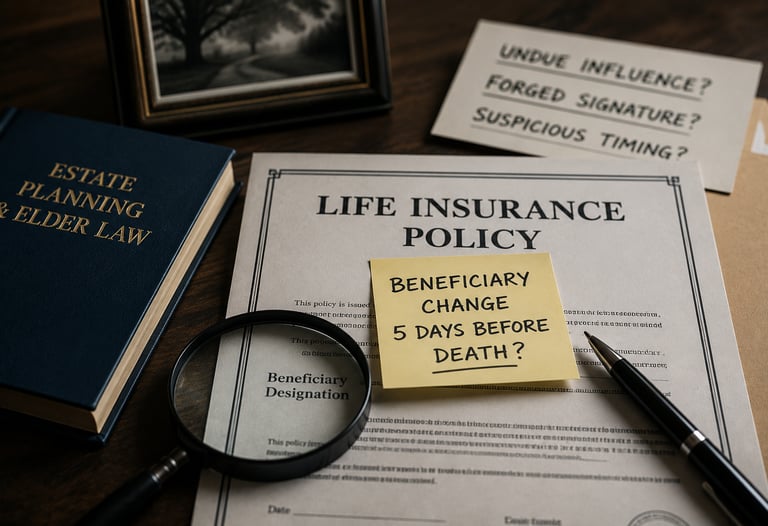
Life insurance is intended to protect families, spouses, children, business partners, and loved ones after a death. In many cases, a life insurance policy provides financial stability during one of the most difficult moments a family will ever face. However, when a beneficiary change occurs under suspicious circumstances, that same policy can become the center of a serious fraud investigation.
A suspicious life insurance claim may involve a last-minute beneficiary change, a forged signature, undue influence, questionable mental capacity, elder exploitation, false statements on an application, or a person who suddenly appears shortly before the insured’s death and becomes the primary beneficiary.
At PMI, life insurance fraud investigations focus on the facts behind the policy. The question is not only who is listed as the beneficiary. The deeper question is how that person became the beneficiary, whether the insured understood and approved the change, whether the documents are legitimate, and whether someone manipulated the process for financial gain.
Life Insurance Fraud Is Often Hidden in the Timeline
Many suspicious life insurance cases are not obvious at first glance. The paperwork may appear valid. The beneficiary may have a signed form. The insurance company may have processed the change. However, fraud and undue influence often become visible only when the timeline is reconstructed.
Important questions include:
When was the policy created?
When was the beneficiary changed?
Who requested the change?
Who helped complete the paperwork?
Where was the insured at the time?
Was the insured hospitalized, medicated, isolated, or dependent on someone else?
Did the insured have a history of naming a different beneficiary?
Did the new beneficiary have recent financial problems?
Were family members suddenly cut off from contact?
Was the insured vulnerable due to age, illness, disability, grief, addiction, or mental health issues?
A beneficiary change made shortly before death does not automatically prove fraud. However, it is a major red flag when the change does not match the insured’s prior intent, family history, relationship structure, or medical condition.
Common Red Flags in Life Insurance Fraud and Beneficiary Disputes
Life insurance fraud investigations often involve patterns of suspicious conduct. Some of the most common red flags include:
a beneficiary change made days, weeks, or months before death;
removal of a spouse, child, long-term partner, or known family member without explanation;
a caregiver, romantic partner, friend, employee, or unrelated person suddenly named as beneficiary;
signs that the insured was isolated from family;
sudden involvement by someone who had little prior relationship with the insured;
questionable mental capacity at the time of the change;
documents signed while the insured was hospitalized, heavily medicated, cognitively impaired, or near death;
inconsistent signatures;
missing original documents;
suspicious witnesses or notary information;
policy changes made through online access controlled by another person;
unexplained premium payments by the new beneficiary;
death occurring shortly after the policy was changed or created;
competing claims from multiple people;
false or misleading information submitted to the insurer.
These red flags are not proof by themselves. They are indicators that the policy, documents, relationships, and timeline should be investigated.
Florida Insurance Fraud Considerations
Florida law addresses false and fraudulent insurance claims under Florida Statute § 817.234. The statute applies to certain false, incomplete, or misleading statements made in connection with an insurance claim or application when made with intent to injure, defraud, or deceive an insurer.
Life insurance disputes may also involve misrepresentations in insurance applications. Under Florida Statute § 627.409, a misrepresentation, omission, concealment of fact, or incorrect statement may affect recovery under an insurance policy if it is fraudulent, material to the risk, or would have affected the insurer’s decision to issue the policy or provide coverage.
When the insured is elderly or disabled, another Florida statute may become relevant. Florida Statute § 825.103 addresses exploitation of an elderly person or disabled adult, including knowingly obtaining or using, or attempting to obtain or use, the person’s funds, assets, or property with intent to temporarily or permanently deprive that person of the use, benefit, or possession of those assets.
PMI does not determine who is legally entitled to life insurance proceeds. That decision belongs to the insurer, the court, or the attorneys involved. PMI’s role is to investigate the facts, identify inconsistencies, locate witnesses, document timelines, and assist counsel in determining whether fraud, undue influence, exploitation, or document manipulation may have occurred.
Illegal Beneficiaries, Undue Influence, and Financial Motive
An illegal or improper beneficiary issue can arise when someone is named as the beneficiary through fraud, coercion, forgery, exploitation, or undue influence. On paper, the beneficiary designation may appear valid. But the circumstances behind that designation may tell a different story.
Undue influence often involves pressure placed on a vulnerable person. The insured may be elderly, sick, dependent, isolated, grieving, medicated, or mentally impaired. The person exerting influence may control access to the insured, handle communications, manage transportation, assist with documents, or create separation between the insured and family members.
Financial motive is also a major investigative issue. A beneficiary who had debt, recent financial stress, legal problems, addiction issues, gambling problems, or a history of exploiting others may require closer review. The investigation should examine not just the policy documents, but the relationship between the insured and the beneficiary.
What PMI Investigates
A life insurance fraud investigation may require review of multiple categories of information. PMI can assist attorneys and families by investigating:
the history of the policy;
the original and changed beneficiary designations;
the timing of all policy changes;
witnesses involved in signing documents;
the insured’s health and living situation at the time of the change;
relationships between the insured and all beneficiaries;
communications before and after the change;
possible isolation from family;
suspicious financial motive;
public records involving involved parties;
civil, criminal, probate, and financial history;
social media evidence;
caregiver involvement;
possible elder exploitation;
inconsistencies in signatures, documents, and timelines.
The goal is to create a clear factual record. That record can help attorneys determine whether to challenge a beneficiary designation, contest a claim, notify an insurer, pursue civil litigation, seek probate court involvement, or refer the matter to law enforcement or regulatory authorities.
Why Families Should Not Wait
Life insurance fraud investigations should begin as soon as suspicious facts are discovered. Delay can damage the case.
Witness memories fade. Text messages are deleted. Social media accounts are changed. Documents disappear. Phones are replaced. Financial records become harder to trace. People involved in the claim may change their statements once they realize the matter is being questioned.
If a suspicious beneficiary change is discovered, families should avoid confronting the suspected person without legal advice. A confrontation can cause evidence to disappear and may alert the person to destroy records or coordinate stories. The safer approach is to document what is known, preserve available records, contact an attorney, and begin a lawful investigation.
Life Insurance Fraud Often Overlaps With Other Investigations
Life insurance beneficiary disputes often overlap with several other investigative areas, including:
elder exploitation;
probate disputes;
suspicious death investigations;
estate litigation;
financial fraud;
forged documents;
caregiver misconduct;
family law issues;
business partner disputes;
missing records;
undue influence claims.
For example, a suspicious beneficiary change may not be an isolated event. It may be part of a broader pattern where the same person gained control over bank accounts, property, vehicles, legal documents, medical decisions, or estate planning documents before the insured’s death.
That broader pattern matters. A professional investigation should not look at the policy in isolation. It should examine the full relationship, timeline, and control structure surrounding the insured.
The Role of Attorneys and Investigators
Life insurance fraud matters often require both legal and investigative work. Attorneys handle the legal strategy, court filings, insurer communications, subpoenas, probate issues, and claims disputes. Investigators support that legal work by developing facts, locating witnesses, reviewing records, documenting timelines, and identifying evidence that may not appear in the policy file.
The insurance company may conduct its own review, but its review may be limited to the claim and policy documents. A private investigation can go further by examining the people, relationships, motives, and factual circumstances surrounding the beneficiary change.
This is especially important when the family believes the insured would never have voluntarily made the change.
Life insurance fraud and illegal beneficiary disputes can be complex, emotional, and financially significant. A beneficiary form may show who is listed to receive the money, but it does not always explain how that person became the beneficiary or whether the change was lawful, voluntary, and legitimate.
When a life insurance beneficiary change raises red flags, the facts must be investigated quickly and professionally.
PMI assists attorneys, families, and interested parties with life insurance fraud investigations, suspicious beneficiary changes, undue influence concerns, elder exploitation indicators, and document-related inconsistencies. When the policy does not tell the whole story, PMI follows the evidence.