
Locard’s Principle: Why Every Contact Leaves a Trace
PMI Forensics Services Division
6/11/20266 min read
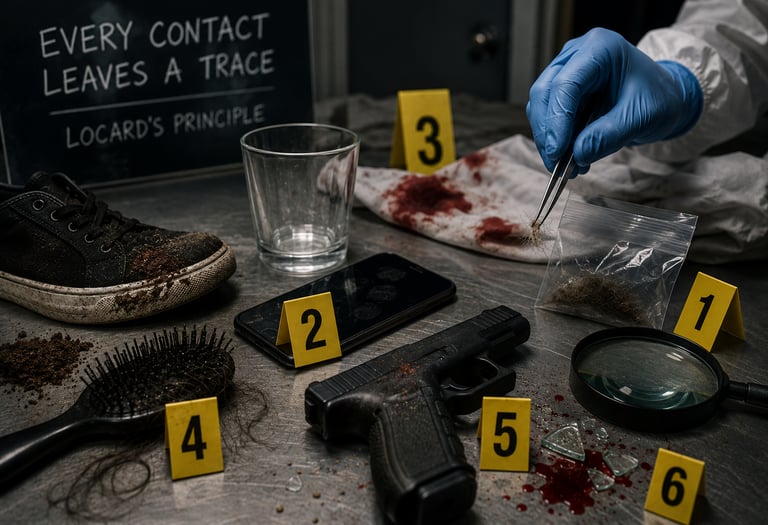
In forensic investigations, one of the most important concepts for understanding a crime scene is known as Locard’s Principle.
The principle is simple, but powerful:
Whenever two objects come into contact, they mutually exchange materials.
In plain language, when a person enters a scene, touches an object, walks across a surface, struggles with another person, enters a vehicle, handles a weapon, breaks a window, or comes into contact with a victim, something may be transferred.
That transfer may be obvious, like blood on clothing, or it may be nearly invisible, like fibers, hair, skin cells, glass fragments, soil, fingerprints, gunshot residue, or trace DNA.
At PMI | Preventative Measures Investigation — Forensic Services Division, Locard’s Principle is one of the foundational concepts we use to explain why proper crime scene documentation, evidence preservation, and independent review are so important.
What Is Locard’s Principle?
Locard’s Principle is named after Dr. Edmond Locard, a pioneer in forensic science. His basic theory was that every contact leaves a trace. When two people, objects, or environments come into contact, there is an exchange of material between them.
This concept applies to nearly every type of investigation.
A suspect may leave something behind at a scene.
A victim may carry away evidence from the person who harmed them.
A weapon may contain biological material, fingerprints, or fibers.
A vehicle may contain soil, hair, blood, glass, or clothing fibers.
A person’s shoes may transfer dirt, vegetation, or debris from one location to another.
A broken window may transfer glass fragments onto clothing, skin, or the floor.
The value of Locard’s Principle is that it reminds investigators to look beyond the obvious. A scene is not just a location. It is a physical environment where movement, contact, and transfer may have occurred.
Why This Matters at a Crime Scene
A crime scene is fragile. Evidence can be lost, moved, contaminated, overlooked, or misunderstood. Once the scene changes, investigators may never be able to fully recreate it.
That is why the first response, documentation, photography, collection, and preservation of evidence matter so much. If evidence is not properly recognized and preserved, it may disappear before anyone realizes its importance.
For example, a small fiber on a victim’s clothing may help connect a person to a vehicle or location. A trace amount of blood may contradict a witness statement. A footprint may show movement through the scene. A broken glass fragment may help determine whether someone entered or exited through a window. A transfer stain may reveal contact between two surfaces.
Individually, these details may seem minor. Together, they may help establish a timeline, confirm or challenge statements, identify inconsistencies, or raise reasonable doubt.
Evidence Is Not Always Obvious
One of the biggest mistakes the public makes when thinking about forensic evidence is assuming that important evidence is always visible. In reality, some of the most important evidence may be small, hidden, microscopic, or easy to destroy.
Trace evidence may include:
hair;
fibers;
skin cells;
fingerprints;
DNA;
blood;
saliva;
soil;
dust;
pollen;
glass;
paint;
gunshot residue;
tool marks;
footwear impressions;
tire impressions.
This is why a crime scene cannot be judged only by what appears obvious in a police report or a few photographs. The absence of visible evidence does not always mean nothing happened. It may mean the evidence was not looked for, not documented, not collected, not tested, or not properly interpreted.
Locard’s Principle and Criminal Defense
Locard’s Principle is especially important in criminal defense investigations. The State may present a theory of what happened, but that theory must be compared against the physical evidence.
If the prosecution claims that two people were in close physical contact, investigators should ask whether the expected transfer evidence exists.
If the State claims a person handled an object, investigators should ask whether fingerprints, DNA, or other transfer evidence was found.
If a witness claims a person moved through a specific area, investigators should ask whether the scene evidence supports that movement.
If a victim or suspect allegedly came into contact with blood, glass, dirt, clothing, furniture, or a weapon, investigators should ask whether the physical evidence supports or contradicts that claim.
The defense does not have to accept the narrative without scrutiny. The physical evidence must be reviewed to determine whether it supports the allegation, contradicts it, or leaves important questions unanswered.
Transfer Evidence Can Support or Contradict a Statement
Statements are important, but physical evidence may confirm or challenge those statements.
A witness may describe a struggle in one location, while blood transfer, broken objects, or disturbed furniture suggest activity occurred somewhere else. A person may claim they never touched an object, but fingerprint or DNA evidence may suggest otherwise. A suspect may claim they were never inside a vehicle, but fibers, hair, or other trace evidence may raise questions. A scene may show no evidence of expected transfer, which may challenge the claimed sequence of events.
This does not mean every transfer proves guilt. Evidence must be interpreted carefully and within context. Transfer can occur directly, indirectly, innocently, or through secondary contact. That is why forensic evidence must be examined by qualified professionals and reviewed in relation to the full case file.
The Danger of Scene Contamination
Locard’s Principle also explains why contamination is such a serious issue.
If every contact leaves a trace, then every person who enters a scene can potentially add, remove, or move evidence. First responders, officers, witnesses, family members, medical personnel, property owners, or bystanders may unintentionally alter the scene.
That is why scene security matters. Crime scene logs, photographs, body camera footage, collection procedures, and chain of custody are critical. Investigators must know who entered the scene, what was touched, what was moved, what was collected, and whether the evidence was protected from contamination.
In criminal defense cases, PMI reviews these issues carefully. If evidence was contaminated, poorly documented, or collected after the scene was disturbed, that may become an important issue for the defense.
What Investigators Should Ask
When applying Locard’s Principle to a case, investigators should ask:
What people, objects, and surfaces came into contact?
What materials could have transferred?
Was the expected evidence documented or collected?
Was any evidence missing that should reasonably have been present?
Was the scene secured before evidence was disturbed?
Were photographs taken before items were moved?
Were clothing, weapons, vehicles, bedding, flooring, or furniture preserved?
Were DNA, fingerprint, trace, blood, or impression evidence tested?
Were assumptions made before the evidence was fully reviewed?
Does the physical evidence support the witness statements?
Does the evidence support the State’s theory?
Are there unexplained gaps in the investigation?
These questions help separate assumptions from evidence.
Why Independent Review Matters
Law enforcement agencies are responsible for investigating crimes, collecting evidence, and documenting scenes. However, no investigation should be treated as automatically complete simply because a report was written.
Mistakes can happen. Evidence can be missed. Scenes can be contaminated. Photographs can be incomplete. Items can be moved before documentation. Testing may not be requested. Witness statements may be accepted without being compared against the physical evidence.
An independent forensic review can help identify what was done, what was not done, and what questions remain.
PMI | Preventative Measures Investigation — Forensic Services Division assists attorneys, clients, and families by reviewing discovery, photographs, reports, timelines, body camera footage, forensic findings, and scene documentation. The goal is to determine whether the physical evidence supports the official version of events or whether additional review is needed.
Locard’s Principle in Plain Terms
For the public, Locard’s Principle can be understood this way:
When someone enters a scene, they may bring something in.
When someone leaves a scene, they may take something out.
When two people struggle, both may carry evidence from that contact.
When an object is handled, it may retain evidence of that contact.
When a scene is disturbed, evidence may be moved, altered, or destroyed.
That is why forensic investigation is not just about looking at what is visible. It is about understanding contact, transfer, movement, and preservation.
Locard’s Principle is one of the most important concepts in forensic science because it explains why physical contact matters. Every interaction has the potential to leave a trace, and those traces can help investigators understand what happened at a crime scene.
But evidence must be properly recognized, documented, preserved, tested, and interpreted. When that process is incomplete, the truth can be missed.
At PMI | Preventative Measures Investigation — Forensic Services Division, we understand that the details matter. Whether reviewing a criminal defense case, evaluating forensic evidence, or assisting attorneys with investigative support, PMI looks beyond the surface of the report and focuses on the physical facts.
Because at a crime scene, every contact may leave a trace — and every trace may matter.