Why Complex Investigations Require Coordination and Information Sharing
6/16/20265 min read
In professional investigations, no single report, witness statement, database search, or piece of evidence tells the entire story. Complex cases are built from multiple sources of information, and the value of that information depends on how well it is collected, verified, shared, organized, and analyzed.
This is why coordination and information sharing are critical in investigative work.
At PMI | Preventative Measures Investigation, we understand that modern investigations often require more than one investigative method. A case may involve field work, public records, OSINT, cyber forensics, witness location, surveillance, forensic review, attorney coordination, intelligence development, and timeline analysis. When those pieces are not connected, important facts can be missed.
Professional agencies recognize this same principle. The FBI has publicly emphasized the importance of partnerships and information sharing with law enforcement partners to improve collaboration and public safety. The U.S. Marshals Service also relies heavily on task force coordination with federal, state, tribal, and local authorities in fugitive investigations. The lesson is clear: complex investigations require coordinated effort, disciplined communication, and a shared understanding of the facts.
Information Alone Is Not Enough
Information becomes valuable only when it is placed into context.
A name in a report is information.
A vehicle tag is information.
A social media profile is information.
A witness statement is information.
A surveillance observation is information.
A phone number, address, business record, or court filing is information.
But information by itself is not always intelligence. It must be evaluated, corroborated, connected to other facts, and organized into a form that supports decision-making.
For example, a witness may provide a name. OSINT may identify a social media profile connected to that name. Public records may reveal prior addresses. Surveillance may confirm a current location. Digital evidence may establish communication. A timeline may show where that person fits into the case.
Each piece matters, but the full value comes from connecting them.
Why Coordination Matters
Complex investigations often involve multiple people, records, locations, agencies, attorneys, witnesses, and evidence sources. Without coordination, the investigation can become fragmented.
Important questions may go unanswered:
Who has the latest information?
What has already been verified?
Which leads are still open?
What evidence has been preserved?
Which witnesses have been contacted?
What records are still missing?
What facts are confirmed, and what remains unverified?
Where are the conflicts in the case?
A coordinated investigation helps prevent duplication, confusion, and missed opportunities. It also helps ensure that everyone working on the matter understands the current investigative picture.
In legal matters, coordination is especially important. Attorneys need information that is organized, relevant, and documented. Investigators need clear objectives and lawful direction. Forensic consultants may need access to records, photos, files, or timelines. Clients need to understand what has been found and what still needs to be developed.
When communication breaks down, the case suffers.
Information Sharing Must Be Controlled and Lawful
Information sharing does not mean sharing everything with everyone. Professional investigations require discretion, confidentiality, and proper control of sensitive information.
Some information may be protected by attorney-client privilege, work product protections, privacy laws, court orders, confidentiality agreements, or investigative necessity. Digital evidence may require preservation procedures. Witness information may need to be handled carefully. Sensitive personal information must be protected.
At PMI, information sharing is approached with purpose. The question is not simply who wants the information. The question is who needs it, why they need it, whether sharing is lawful, and how it should be documented.
Controlled information sharing helps protect the integrity of the case.
The Role of Attorneys, Investigators, and Specialists
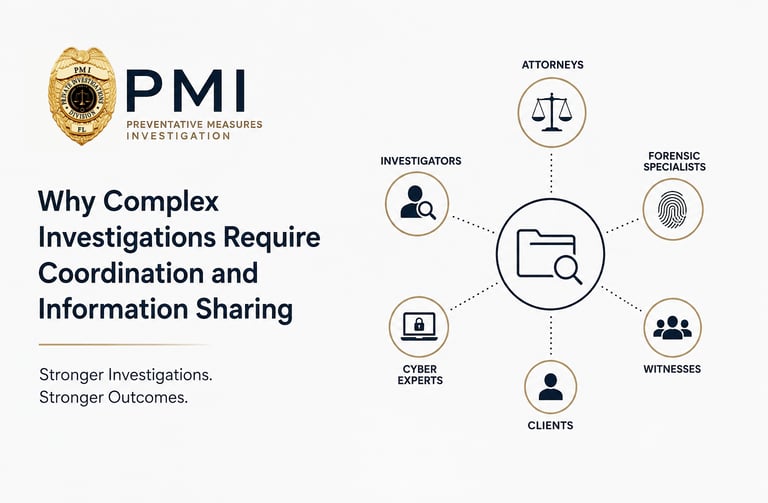
Many investigations require collaboration between attorneys, investigators, forensic specialists, cyber professionals, subject matter experts, security providers, and clients.
Each role is different.
Attorneys provide legal strategy, subpoenas, court filings, privilege guidance, discovery review, and legal direction. Investigators develop facts, locate witnesses, review records, conduct field work, prepare timelines, document findings, and identify inconsistencies. Cyber forensics professionals may assist with digital evidence preservation, device review, metadata, online accounts, and electronic records. Forensic consultants may assist with crime scene review, bloodstain evidence, trace evidence, fingerprints, DNA issues, or other technical evidence concerns.
When each role is properly coordinated, the investigation becomes stronger.
The goal is not to collect random information. The goal is to collect the right information, from the right sources, in the right way, and organize it so it can support the case objective.
Coordination in Criminal Defense Investigations
In criminal defense cases, coordination can be the difference between a surface-level review and a meaningful defense investigation.
Police reports may not include every fact. Body-worn camera footage may reveal details that are not written in the report. Witnesses may provide information that was never documented. CAD records may show timing issues. Crime scene photos may reveal evidence that contradicts a statement. Forensic reports may raise questions that require expert review.
A defense investigation must bring these materials together.
PMI assists defense attorneys by reviewing discovery, identifying missing records, developing timelines, locating witnesses, comparing statements, documenting inconsistencies, and coordinating with forensic or cyber specialists when appropriate.
The purpose is to give counsel a clearer understanding of the case, not just a stack of documents.
Coordination in Fraud and Civil Investigations
Fraud investigations also require disciplined coordination. A fraud case may involve bank records, business filings, contracts, real estate documents, insurance forms, emails, text messages, public records, surveillance, interviews, and digital evidence.
Without coordination, the paper trail can become overwhelming.
PMI helps clients and attorneys organize information into a structured investigative picture. That may include identifying involved parties, mapping relationships, reviewing timelines, locating assets or records, documenting suspicious transactions, and preserving evidence.
In civil litigation, the ability to organize facts can directly affect case strategy. A well-coordinated investigation helps attorneys understand what happened, who was involved, when events occurred, and what records support the findings.
Coordination in Missing Person and Location Investigations
Missing person and location investigations are another example of why coordination matters.
A missing person case may involve family members, friends, employers, public records, law enforcement, hospitals, shelters, social media, financial indicators, vehicle information, phone activity, prior addresses, and last-known-location data.
No single source is usually enough.
A coordinated approach helps investigators build a timeline, identify last confirmed contact, develop leads, locate witnesses, and determine what information is reliable.
PMI’s role is to organize leads, separate confirmed facts from assumptions, and continue developing the investigative picture.
Turning Information Into an Investigative Picture
The strongest investigations are not just active. They are organized.
A professional investigative process should help answer:
What do we know?
How do we know it?
Where did the information come from?
Has it been verified?
What does it connect to?
What conflicts with it?
What evidence supports it?
What still needs to be done?
This is where timelines, reports, evidence indexes, link analysis, OSINT findings, witness summaries, and investigative notes become valuable. They help transform scattered information into an investigative product that can be reviewed, shared appropriately, and acted upon.
PMI’s Approach
PMI | Preventative Measures Investigation provides investigative support built around coordination, documentation, and analysis.
Our services include private investigations, intelligence, OSINT, cyber forensics, forensic services, fraud investigations, criminal defense investigations, missing persons investigations, surveillance, and litigation support.
In complex matters, PMI works to identify the facts, organize the evidence, preserve key information, and support the client’s objective. Whether the case involves an attorney, business, family, private client, or multiple investigative disciplines, PMI focuses on building a clear and supportable investigative record.
Complex investigations require more than effort. They require coordination.
Information must be collected, verified, protected, organized, and shared appropriately. Witnesses, records, digital evidence, forensic issues, timelines, and investigative leads must be connected into a clear picture.
Professional agencies understand that partnerships and information sharing improve investigative outcomes. The same principle applies to private investigations, criminal defense support, fraud matters, missing persons, cyber forensics, and litigation support.
At PMI | Preventative Measures Investigation, we believe that facts are strongest when they are properly documented, properly analyzed, and properly coordinated.
When the case is complex, coordination is not optional. It is part of the investigation.